In today's rapidly evolving digital landscape, businesses depend heavily on technology to drive productivity, support customers, and maintain operational continuity. From cloud computing and cybersecurity to remote work infrastructure and business applications, IT systems have become the backbone of modern organizations. As technology environments grow more complex, so does the demand for efficient and reliable IT support.
At the same time, Artificial Intelligence (AI) is transforming how businesses manage technology. AI-powered chatbots, automated help desks, predictive monitoring systems, and intelligent cybersecurity tools are becoming increasingly common. These innovations promise faster response times, reduced operational costs, and around-the-clock support capabilities.
However, despite the growing capabilities of AI, human IT professionals continue to play an indispensable role in business technology management. While AI excels at automation and data analysis, human experts bring critical thinking, creativity, strategic planning, and emotional intelligence that technology cannot fully replicate.
This raises an important question for business leaders: Should organizations rely on AI-powered IT support, human IT support, or a combination of both?
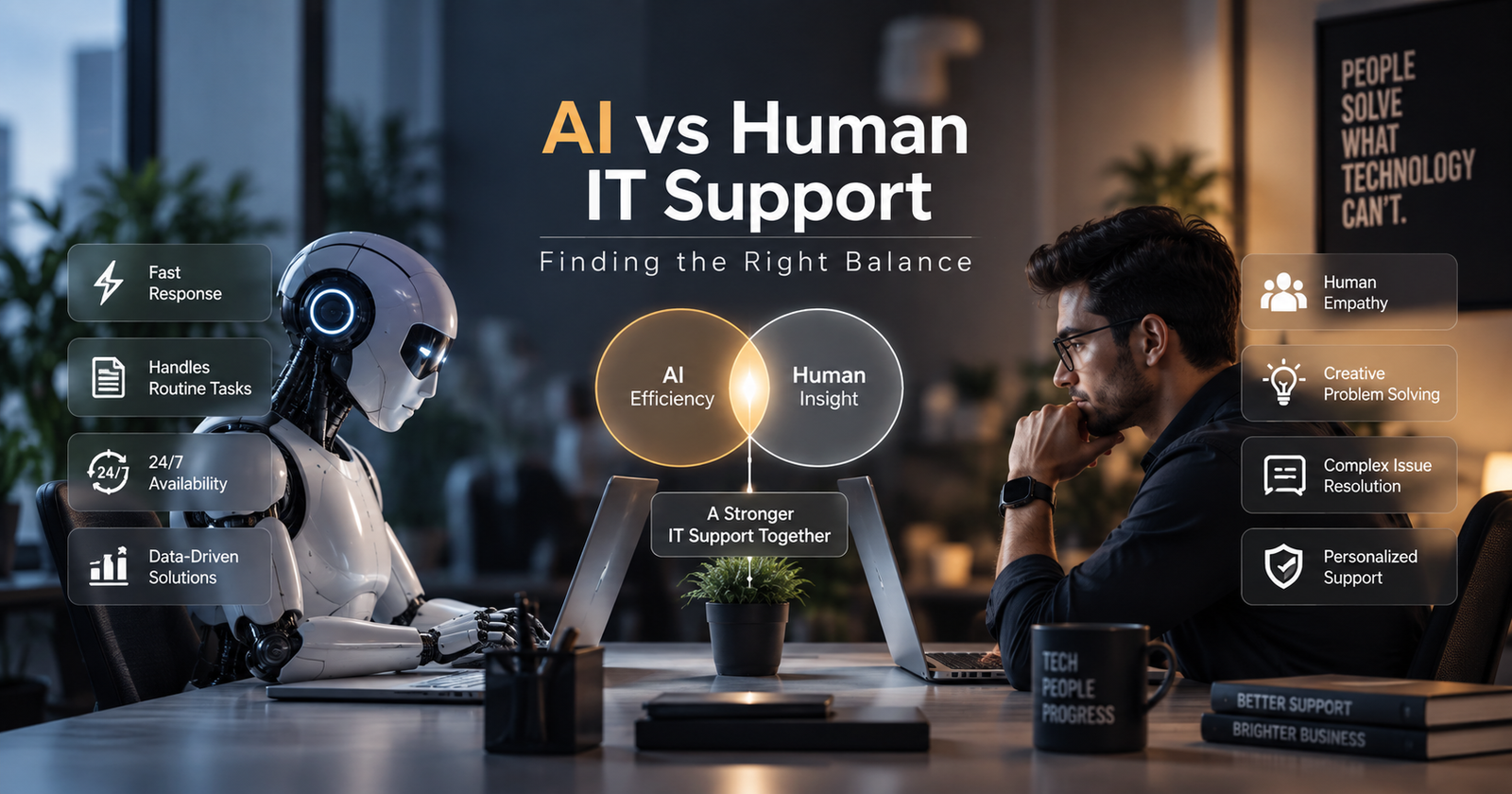
The reality is that neither AI nor human support alone can deliver the perfect solution. The most effective approach is finding the right balance between automation and human expertise. Businesses that successfully integrate both can improve efficiency, enhance user experiences, strengthen security, and gain a competitive advantage in today's technology-driven world.
Understanding AI-Powered IT Support
Artificial Intelligence has become one of the most influential technologies in the IT industry. Modern AI systems can process vast amounts of information, recognize patterns, learn from historical data, and perform tasks that traditionally required human intervention.
In the context of IT support, AI is being used to automate repetitive processes, improve service delivery, and assist users with common technical issues. Many organizations are implementing AI-driven tools to handle large volumes of support requests while allowing human technicians to focus on more strategic responsibilities.
Common applications of AI in IT support include:
- Automated chatbots and virtual helpdesk assistants
- Intelligent ticket classification and priority routing
- Self-service automated password resets and access provisioning
- Predictive maintenance and proactive system monitoring
- Automated software updates and security patch deployment
- Real-time cybersecurity threat and anomaly detection
- Smart knowledge base recommendations for end-users
- Automated network performance diagnostics and optimization
The Key Advantages of AI in IT Support
One of the primary reasons businesses are investing in AI-powered support solutions is the ability to deliver faster and more consistent service:
- 24/7/365 Non-Stop Availability: AI systems provide instant support around the clock without shift constraints or holiday downtime, critical for distributed and global teams.
- Instant Response and Resolution: Routine requests such as password resets and access permissions can be completed in seconds without queuing.
- Significant Cost Efficiency: Automating repetitive Level 1 support tasks drastically lowers per-ticket overhead costs and allows IT teams to scale without linear payroll growth.
- Predictive System Monitoring: AI analyzes server logs, network traffic, and disk metrics to detect patterns indicating hardware failure or memory leaks before outages occur.
- Rapid Scalability: During business expansion or sudden support surges, AI accommodates thousands of simultaneous requests without bottlenecks.
Where AI Falls Short: Current Limitations
Despite its remarkable capabilities, AI is not a complete replacement for human expertise:
- Lack of Human Judgment & Context: AI operates strictly within algorithms and training models. When encountering multi-faceted integration bugs or business-specific legacy setups, it often lacks contextual awareness.
- Absence of Emotional Intelligence & Empathy: When mission-critical systems fail during tight deadlines, frustrated employees need empathetic reassurance and active listening—qualities algorithms cannot provide.
- Risk of Hallucinations and Inaccurate Guidance: If presented with ambiguous queries, AI can provide incorrect troubleshooting steps that may exacerbate system issues.
- Limitations in Complex Cybersecurity Incident Response: While AI identifies anomalies, orchestrating forensic containment, stakeholder communications, and regulatory reporting demands experienced human security analysts.
The Enduring Value of Human IT Support
Human IT professionals remain the cornerstone of resilient technology environments:
- Critical Thinking & Creative Problem Solving: Humans excel at investigating elusive root causes across interconnected cloud architectures where standard playbooks fall short.
- Strategic vCIO & Business Alignment: Experienced IT leaders understand your company's business goals, advising on technology investments, cloud migration roadmaps, and compliance readiness.
- Personalized Solutions & Relationship Building: Dedicated technicians build long-term trust, understanding the nuanced operational workflows of different teams within your organization.
- Ethical and High-Stakes Decision Making: When balancing security policies against operational agility, human leaders apply nuanced judgment that automated algorithms cannot match.
The Limitations of Human-Only IT Support
Relying exclusively on human teams also comes with distinct drawbacks:
- Availability Constraints: Around-the-clock manual staffing requires multi-shift coverage that can be cost-prohibitive for small to mid-sized businesses.
- High Staffing & Training Overhead: Hiring, onboarding, and certifying specialized engineers requires ongoing budget commitments.
- Queue Backlogs During Peak Hours: High volumes of basic tickets (like password resets) can overwhelm staff, slowing down resolutions for critical incidents.
- Human Fatigue and Consistency Gaps: Repetitive tasks increase the likelihood of manual oversight or configuration mistakes.
Why a Hybrid IT Support Model Works Best
The ideal modern support model does not force a choice between AI and humans—it combines them into a high-performance Hybrid IT Support Framework:
| Support Capability | AI-Powered Automation | Human IT Experts |
|---|---|---|
| Routine Tasks & Password Resets | Instant & Automated (Seconds) | Oversight only when escalated |
| Availability | 24/7/365 Instant Response | Scheduled shifts & On-Call escalations |
| Complex Troubleshooting | Diagnostic log collection & hints | Root-cause analysis & custom remediation |
| Cybersecurity Response | Real-time threat detection & isolation | Forensic investigation & strategy |
| Strategic vCIO Guidance | Trend analysis & reports | Custom roadmap & budget alignment |
| User Experience | Frictionless self-service | Empathetic, personalized assistance |
A Real-World Example of AI and Human Collaboration
Consider an employee locked out of their critical accounting software during monthly closing:
- AI Frontline: The user connects with the automated assistant. The AI securely verifies MFA, checks the status of the cloud database, runs self-diagnostics, and recognizes that the issue is an active directory permission mismatch.
- Smart Escalation: The AI pre-populates a diagnostic brief with server event logs and immediately routes the ticket to the senior systems administrator.
- Human Resolution: The technician bypasses basic triage, adjusts the role hierarchy within minutes, and calls the user to confirm full access is restored.
This combined approach reduces resolution time from hours to minutes while delivering a white-glove experience.
The Future of IT Support
As machine learning models and generative AI mature, automation will handle even more preventative maintenance and self-healing infrastructure. However, organizations will continue to depend on human visionaries to steer digital transformation, architect resilient networks, and safeguard business data.
How Mounteko Helps Businesses Achieve the Right Balance
At Mounteko Global Solutions, we deliver the best of both worlds. Our managed IT and cloud hosting services leverage enterprise-grade AI monitoring and automation tools paired with a 24/7 team of certified IT engineers and cybersecurity specialists.
- Predictive 24/7 Infrastructure Monitoring & Automated Alerts
- Dedicated Help Desk staffed by Certified Tier 1–3 Engineers
- Strategic vCIO Consulting & Digital Transformation Roadmaps
- Advanced Cloud Hosting (QuickBooks, ERP, Dedicated Servers)
- Comprehensive Backup, Disaster Recovery & Endpoint Security
Conclusion
The most resilient and agile businesses in 2026 are not replacing humans with AI—they are empowering their human teams with AI. By adopting a balanced hybrid IT support model, your organization achieves rapid ticket resolutions, lower operational expenses, hardened security, and unparalleled user satisfaction.
To discover how a hybrid managed IT model can modernize your business infrastructure, visit Mounteko.com today.